
Peptide pen or vial?
The same compound, two containers, and a genuine trade-off: the pen removes handling steps and the errors that live in them, the vial keeps the flexibility the pen gives up. Which matters more depends on the work.
One compound, two formats
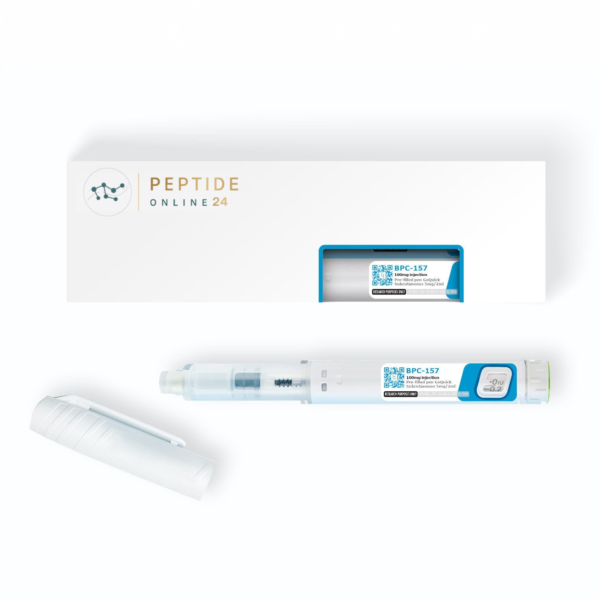
A pre-filled pen is a cartridge at a fixed concentration behind a dial that moves a fixed volume per increment. Reconstitution, measurement and repeatability are handled at manufacture; what reaches you is a dosing instrument.
A research vial is lyophilised powder. Concentration does not exist until you create it with the water you add, which means every downstream number is yours to set — and yours to get wrong.
Neither format changes the compound. The certificate of analysis speaks to what is in the container; the container decides how much handling stands between that material and a measured quantity.
The trade-off, row by row
Where each format wins, without pretending either always does.
| Pre-filled pen | Research vial | |
|---|---|---|
| Reconstitution | Done at manufacture | Yours to perform and record |
| Concentration | Fixed; printed on the cartridge | Set by the water you add |
| Measurement | Dial increments, mechanically repeatable | Drawn by eye into a syringe |
| Flexibility | None after filling | Full — any concentration a protocol needs |
| Handling error surface | Small | Larger — every step is manual |
| Extras needed | Pen needles only | Bacteriostatic water, syringes, technique |
| Typical fit | Standing protocols at standard quantities | Variable protocols, unusual concentrations |
| Price per mg | Higher — the convenience is manufactured in | Lower |
Both formats carry the same purity standard and the same per-batch documentation in this catalogue. The difference is workflow, not quality.
Let the protocol pick the container
If the work runs at one standard quantity for weeks, the pen’s case is strong: the mechanical repeatability is the point, and the inflexibility never gets tested. This is why most of our catalogue ships as pens.
If the work sweeps concentrations, needs unusual measures, or consumes material at a rate where price per milligram dominates, the vial earns its extra handling. This is why the compounds most requested by that kind of work — semaglutide and retatrutide among them — ship as vials here.
The wrong reason to choose a vial is to save money on work that never needed the flexibility; the wrong reason to choose a pen is dial convenience for a protocol the fixed concentration cannot actually serve. Both mistakes are common and both are avoidable in one minute of arithmetic.
Both formats, same standard
Pens, vials and the water that vials need — all batch-documented at 99% minimum.
The practical pages
The handling knowledge each format assumes.
About the formats
Asked whenever both formats of one compound exist.
Is the compound identical in both?
Why are pens more expensive per milligram?
Can I draw from a pen cartridge with a syringe?
Which format lasts longer?
Browse both, choose once
The catalogue is split by format precisely so this decision can be made deliberately instead of by accident.
For laboratory and research use only. Not for human or animal consumption. Not a medicine and not a food supplement. Sold to persons aged 18 and over.